Sea Turtles Maldives: Best Spots, Species & Season
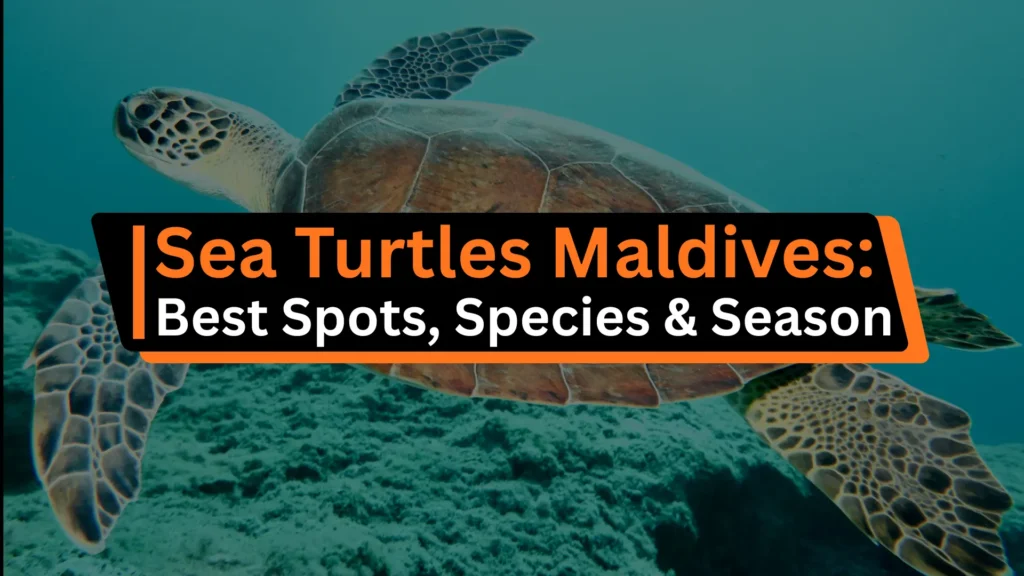
Sea turtles are one of the few marine encounters in the Maldives you don’t need a liveaboard or a deep dive to get close to — they turn up on shallow house reefs, seagrass beds, and snorkelling trips just as reliably as they do on scheduled dives.
The Maldives hosts five of the world’s seven sea turtle species, though in practice divers and snorkellers will almost always encounter just two: the Green and the Hawksbill. This guide covers which species you’ll actually see, the best atolls and resorts for sightings, the season that gives you the best odds, and the encounter rules every diver should know before getting in the water.
1. Can You See Sea Turtles in the Maldives?
Yes — reliably so. Turtles are one of the most consistently sighted marine animals in the Maldives, found on house reefs, seagrass beds, and dedicated dive sites across almost every atoll. Unlike whale sharks or mantas, which are seasonal and location-specific, turtles show up on ordinary dives and snorkels year-round.
🐢 Found in shallow water close to shore as well as on deeper reef dive sites — no need for a liveaboard specifically to see one
📸 Some house reefs report turtle sightings on the majority of dives, though sightings are never guaranteed since they’re wild animals
🌊 Both snorkellers and divers regularly encounter turtles, making this one of the few marine highlights accessible at every certification level
| 💡 Pro Tip: If turtles are a priority for your trip, ask your resort or liveaboard operator directly which house reef or dive site has the most consistent sightings — some islands (like Kuredu in Lhaviyani Atoll) are known specifically for resident turtle populations rather than passing encounters. |
2. Which Turtle Species Are Found in the Maldives?

Five of the world’s seven sea turtle species have been recorded in the Maldives, but two account for almost every sighting divers actually have:
| Species | How Common | Where You’ll See Them |
| Hawksbill Turtle | Most frequently sighted | Coral reefs and feeding areas — mostly juveniles |
| Green Turtle | Very common, less than Hawksbill | Seagrass beds; more nesting adults recorded |
| Olive Ridley | Occasional | Open water; known for synchronised nesting |
| Loggerhead | Rare | Critically endangered, very infrequent sightings |
| Leatherback | Extremely rare | Occasional visitor; the largest sea turtle species |
| 💡 Pro Tip: Hawksbills are easiest to identify by their narrow, hawk-like beak and patterned gold-and-brown shell — they’re the species you’re most likely to photograph reef-side. Greens have a rounder head and are more often seen grazing seagrass than perched on coral. |
| ⚠️ Hawksbills Are Critically Endangered: Despite being the turtle you’ll see most often, the Hawksbill is critically endangered, and most individuals encountered in the Maldives are juveniles. Frequent sightings don’t mean the population is secure — it’s part of why encounter etiquette (Section 6) matters. |
3. Best Time to See Turtles in the Maldives
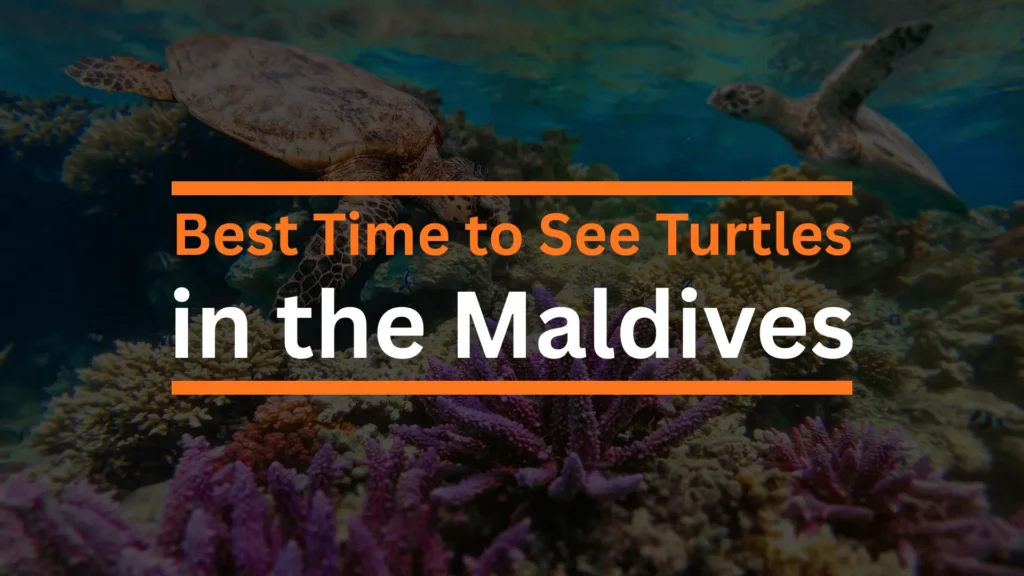
Turtles are present year-round, but visibility and sea conditions still make some months better than others for spotting them clearly:
☀️ January to March: the clearest water of the year, generally considered the best window for turtle photography and snorkelling visibility
🌦️ May to November (SW monsoon): sightings continue, but choppier surface conditions on the western side of atolls can reduce visibility on some days
🥚 July–August: nesting season activity picks up on quieter, uninhabited islands, and hatchling releases are sometimes offered as a guest activity at select resorts
| 💡 Pro Tip: Turtle sightings are far less seasonal than whale sharks or mantas — if turtles are your main goal, you can plan the trip around the general best-visibility window (Jan–Mar) without worrying about missing a narrow migration season. |
4. Best Atolls & Resorts for Turtle Encounters
| Atoll | Why It’s Notable |
| Baa Atoll | UNESCO Biosphere Reserve; healthy reefs with frequent Green turtle sightings |
| Lhaviyani Atoll (Kuredu) | Kuredu Caves holds the largest resident Green turtle population in the Maldives; Turtle Rock is a dedicated hawksbill site |
| South & North Ari Atoll | Diverse dive sites including Orimas Thila, known for turtles alongside reef sharks and rays |
| North Malé Atoll | Easily accessible from Malé; consistent reef sightings |
Several individual resorts have also built reputations specifically around resident turtle populations rather than passing sightings — Kuredu and Hurawalhi (both in Lhaviyani Atoll) are among the most frequently mentioned for their seagrass beds and healthy house reefs.
| 💡 Pro Tip: For a deep dive into one of these islands, see our full Kuredu Island Resort Review — it covers the Turtle Rock and Kuredu Caves sites in more detail, both accessible to snorkellers as well as certified divers. |
🏨 Want to Stay on a Turtle-Rich Island?
To maximize your chances of swimming with green sea turtles daily, choosing a resort with a protected seagrass meadow or an active house reef is key.
- Top Pick for Turtles (Kuredu): Check real-time rates and availability for Kuredu Island Resort on Trip.com →
- Baa Atoll Eco-Resorts: Browse top-rated marine reserve resorts in Baa Atoll on Trip.com →
5. When Do Turtles Hatch in the Maldives?
Nesting happens on quiet, often uninhabited islands, and timing varies by species — but the Maldives as a whole sees nesting activity year-round, with a peak between June and September according to recent nest-monitoring research. Hatchlings typically emerge around 59 days after eggs are laid.
🥚 July and August are commonly cited as the best months to witness hatchlings making their way to the sea, when resorts occasionally offer guided hatchling releases
🏝️ Nesting sites are usually undisturbed, low-light beaches — resorts with nesting turtles typically limit beach lighting at night to avoid disorienting hatchlings
| ⚠️ Don’t Seek Out Nesting Beaches Uninvited: Nesting and hatching sites are sensitive and often monitored by conservation programs. If you want to witness a hatching, go through your resort’s official guest activity rather than looking for nests independently — disturbance during nesting or hatching can be seriously harmful to the turtles. |
🥚 Witnessing the Miracle of Hatching
Resorts like Coco Palm Dhuni Kolhu (Baa Atoll) host dedicated turtle rescue centers in partnership with the Olive Ridley Project, allowing guests to witness monitored hatchling releases.
👉 Find and book eco-certified Maldives resorts on Trip.com →
6. Turtle Encounter Rules — What Divers Need to Know

The Maldives has protected sea turtles by law since 1995, with an indefinite ban on hunting and trade in turtle products confirmed in 2016. As a diver or snorkeller, the rules that matter day-to-day are about respectful distance, not paperwork:
📏 Keep a minimum distance — commonly cited as around 1.8m (6ft) — and never chase or corner a turtle
🚫 Never touch or attempt to ride a turtle; a stressed turtle can deliver a strong bite
↔️ Approach from the side rather than head-on, giving the turtle a clear path to swim away if it chooses to
⬆️ Don’t swim directly above a turtle — they need clear access to the surface to breathe
🍽️ Never feed turtles; it disrupts their natural foraging behaviour
| 💡 Pro Tip: Most dive guides in the Maldives will position the group to the side and slightly behind a turtle automatically — follow their lead and resist the instinct to swim straight toward one for a closer photo. |
7. Turtle Conservation in the Maldives
Turtle conservation is unusually visible in the Maldives compared to other dive destinations, largely thanks to a small number of dedicated organisations working directly with resorts:
🌊 The Olive Ridley Project, founded in 2013, is the country’s largest turtle-focused NGO, best known for rescuing turtles entangled in discarded ghost fishing nets
🏥 Marine Savers and the Atoll Marine Centre (AMC) run rescue and rehabilitation programs in partnership with several resorts, some of which allow guests to visit rehab facilities or attend education sessions
📷 The Maldives National Sea Turtle Identification Programme catalogues individual turtles from guest and diver photographs, using head-scute patterns as a natural fingerprint
If you photograph a turtle clearly during your trip, consider submitting it to one of these identification projects — it’s a small, concrete way divers contribute to the research with almost no extra effort.
👉 Planning a Maldives trip built around marine life encounters? Compare liveaboards on liveaboards.com or resort stays on trip.com
8. Frequently Asked Questions

Q: Can you see turtles in the Maldives?
A: Yes. Turtles are one of the most reliably sighted marine animals in the Maldives, found on house reefs, seagrass beds, and dive sites across almost every atoll, at every certification level from snorkeller to advanced diver.
Q: What time of year do turtles hatch in the Maldives?
A: Nesting occurs year-round with a peak between June and September, and hatchlings most commonly emerge in July and August, roughly 59 days after eggs are laid.
Q: What month are turtles most active?
A: Turtles are present throughout the year, but January to March offers the clearest water and is generally considered the best window for sightings and photography. Nesting-related activity increases around July and August.
Q: Which turtles are found in Maldives?
A: Five of the world’s seven sea turtle species have been recorded — Green, Hawksbill, Olive Ridley, Loggerhead, and Leatherback — but the Hawksbill and Green turtle account for the vast majority of sightings divers and snorkellers actually have.
Final Word
Turtles don’t need a special expedition, a migration season, or a liveaboard itinerary built around them — they’re one of the few marine encounters in the Maldives that show up on an ordinary house reef dive as often as on a dedicated excursion.
That accessibility is exactly why the encounter rules matter. Every diver swimming calmly to the side of a turtle, rather than chasing it for a closer shot, is part of why sightings stay this consistent.
Keep your distance, keep your fins still, and let the turtle decide how close the encounter gets.
Explore More