Eagle Ray Maldives: Where to See Them vs Manta Rays
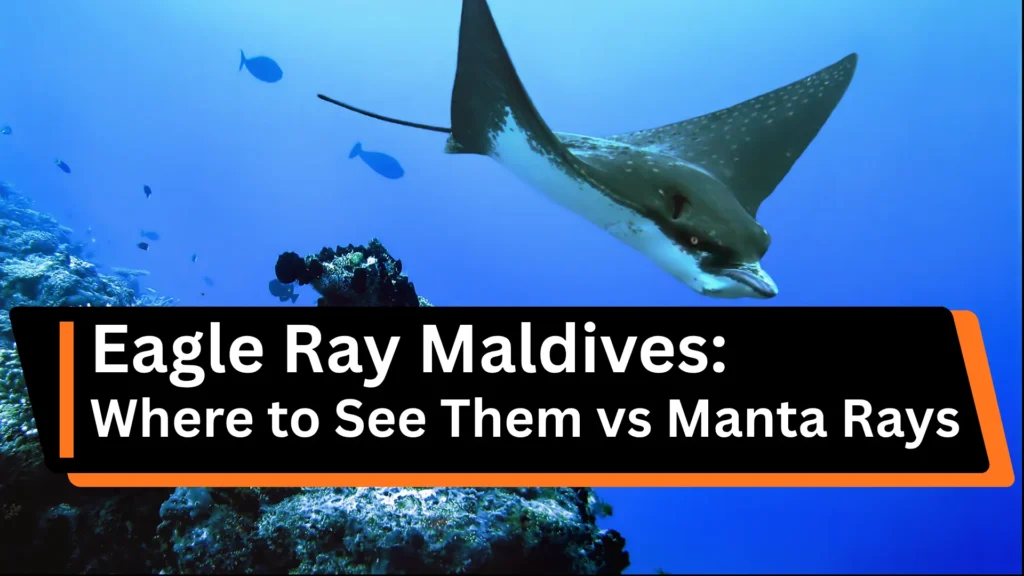
Eagle rays and manta rays are close relatives, they swim the same wing-flapping way, and in the Maldives both can turn up in the same channel, so they get mixed up all the time. This guide sorts out which is which, where eagle rays are actually reported in the Maldives, and why one very rare species gets its own section.
For the wider picture of what lives on these reefs, see our Maldives marine life guide and the Maldives Divers Guide. For mantas specifically, we have a separate guide: Manta Rays in the Maldives.
Eagle ray, manta or stingray? A ten-second ID
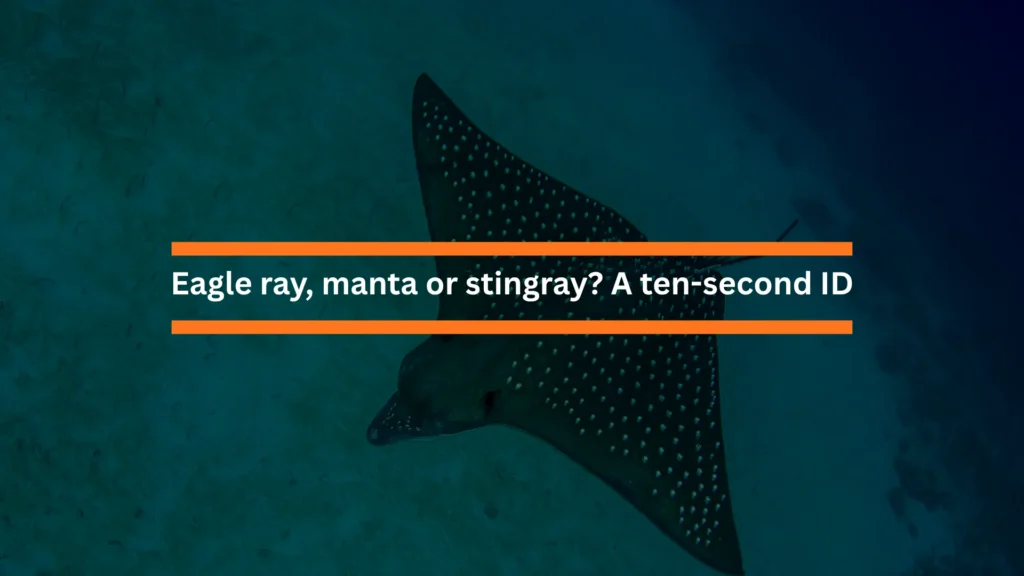
Two checks settle most arguments: look at the front of the head, then at the tail.
| Eagle ray | Manta ray | Stingray | |
| Size across | Usually 1–2 m, up to about 3 m | Mature reef mantas around 5 m | Varies widely; often under 2 m |
| Head | Distinct head with a raised, duck-bill snout | Two horn-like lobes (cephalic fins) either side of the mouth | No distinct head; the disc blends into the body |
| Mouth | Underneath | At the front of the head | Underneath |
| Tail | Long, whip-like, with one or more venomous spines at the base | No stinging spine | One or more venomous spines |
| Shape | Diamond shape with pointed wingtips | Large triangular wings | Round to oval disc |
| Movement | Flaps its wings like a bird; fast, often alone or in small groups | Slow, graceful wing beats; often at cleaning stations or feeding | Ripples its fins; stays near the seabed, often part-buried |
If the ray has horn-like lobes beside its mouth, it is a manta. If it has a duck-bill snout and a long thin tail, it is an eagle ray.
The two eagle rays of the Maldives
Two species are on record in Maldivian waters. One is the ray divers normally see; the other is a rarity that makes the news when it shows up.
Building a trip around rays and sharks?
Compare Liveaboards On Liveaboards.com Or Resort Stays On Trip.com
| Spotted eagle ray | Ornate eagle ray | |
| Scientific name | Aetobatus ocellatus | Aetomylaeus vespertilio |
| In the Maldives | The eagle ray divers usually see | Extremely rare; only a handful of reports |
| Look | Dark back covered in white spots, pale belly, duck-bill snout | Pattern of dark stripes and rings on a golden-grey back, triangular pointed snout |
| Size | Wingspan up to about 3 m | Up to about 2.4 m across |
| IUCN status | Endangered (assessed July 2023; previously Vulnerable) | Critically Endangered (assessed June 2023; previously Endangered) |
| 💡 Worth knowing: the labels you see online are often out of dateBoth species were reassessed by the IUCN in 2023 and moved up a category, but many websites still show the older statuses. Also, many pages call the Maldives’ spotted eagle ray Aetobatus narinari. That name now applies only to the Atlantic species; the Indo-Pacific one, including the Maldives, is Aetobatus ocellatus. |
Where eagle rays are actually reported
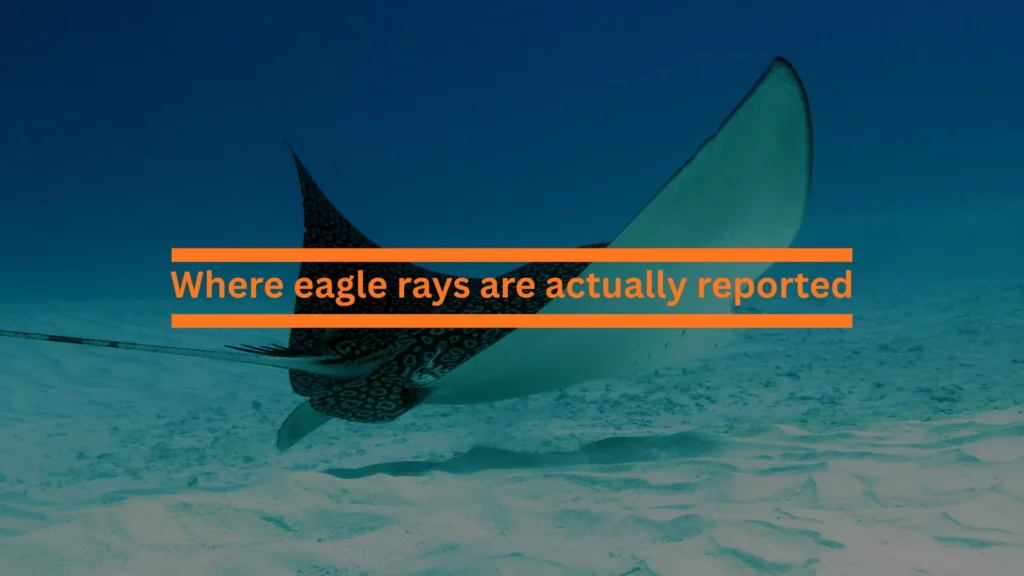
These are reports from dive guides, dive centres and resorts, not survey data. Read each row as “seen here”, not “guaranteed here”.
| Area | Where | What is reported |
| Rasdhoo Atoll | Horseshoe-shaped ridge | Schools of eagle rays alongside grey reef and whitetip sharks (ZuBlu) |
| Vaavu Atoll | Kunaavashi Kandu (“Second Channel”) | “Squadrons” of spotted eagle rays and marbled stingrays (ZuBlu) |
| North Malé Atoll | HP Reef / Rainbow Reef; Furana North; Bandos house reef | Schools of eagle rays on the reef (DiveIn, Scubago, Extreme Maldives dive centre) |
| South Malé Atoll | Rannalhi house reef channel | Eagle rays in the channel (DivePoint, Scubago) |
| Lhaviyani Atoll | Kuredu Express | Grey reef sharks and eagle rays in a strong-current channel (DiveIn, SeaCrush) |
| South Ari Atoll | Veligandu house reef | Resort reports sightings near cleaning stations and lagoons, peaking December to April (Maldives Magazine, resort-sourced) |
| Huvadhoo Atoll | Sandy channels | Groups of 20+ reported by a photographer on a southern atolls trip (Maldives Magazine) |
Resorts also report eagle rays over house reefs and jetties. Milaidhoo links its sightings to medium-to-strong currents from August to February, and Baros says its house reef works the same way, but those timings come from resort write-ups, not from a study. More on the areas above: Vaavu Atoll, Ari Atoll and, for Lhaviyani, our Kuredu Island Resort review.
Building a trip around rays and sharks?
Compare Liveaboards On Liveaboards.com Or Resort Stays On Trip.com
Can you plan a trip around eagle rays?

Not the way you can around whale sharks or mantas, but you can improve your odds.
Choose channels and current-swept reefs. Almost every report above comes from a channel, a thila or a reef with moving water.
Dive more than once at a promising site. Eagle rays are fast, roaming swimmers, so a single dive can easily miss them, unlike mantas, which return to cleaning stations.
Ask the dive centre what has been seen at that site over the last couple of weeks. Recent sightings beat a general reputation.
No source we checked gives a verified season for spotted eagle rays. Reports run through the year, so don’t time a trip around them alone.
If sharks are on your list too, our Sharks of the Maldives guide covers the species that share many of these channels.
The ornate eagle ray: don’t plan around it, but know what you’re looking at
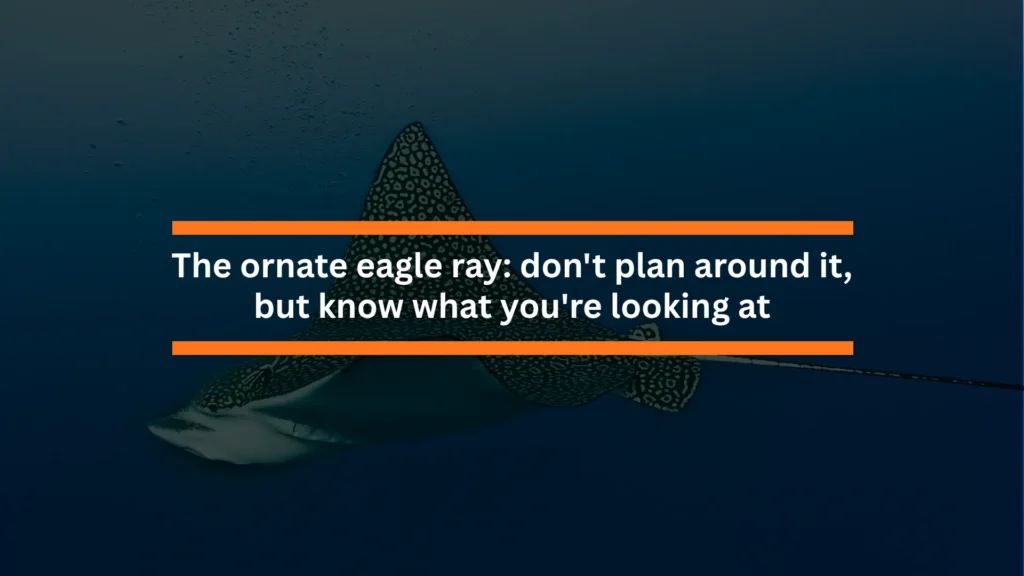
The ornate eagle ray is nicknamed the “unicorn of the sea”. Visit Maldives and Wikipedia both cite fewer than 60 confirmed sightings worldwide, and it is listed as Critically Endangered.
In the Maldives, guests snorkelling the house reef at OBLU NATURE Helengeli (North Malé Atoll) saw one on 30 July 2025. Earlier that year there were reports at OBLU SELECT Sangeli and OBLU XPERIENCE Ailafushi, also in North Malé Atoll.
Hurawalhi, in Lhaviyani Atoll, also describes the species as naturally uncommon and rarely observed, with an occasional sighting.
How to recognise it: a pattern of dark stripes and rings on the back and a triangular pointed snout, shorter than the spotted eagle ray’s. The pattern has been used to identify individual rays.
If you see one, tell your dive centre or the resort’s marine biologist. Research on this species elsewhere has leaned heavily on diver and snorkeller photos and reports, so each record helps. Don’t chase it for a better shot.
Building a trip around rays and sharks?
Compare Liveaboards On Liveaboards.com Or Resort Stays On Trip.com
Are eagle rays dangerous?
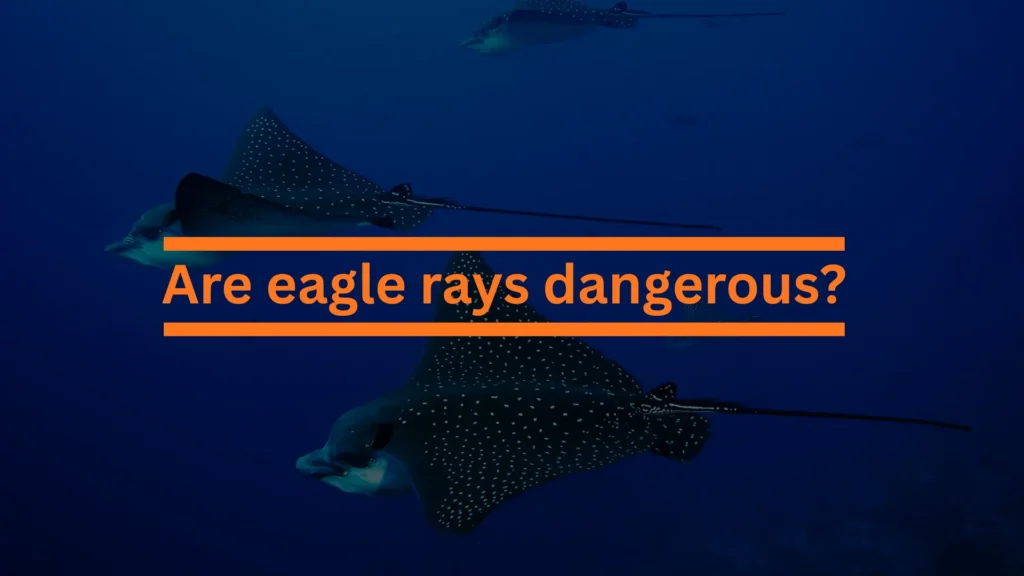
Not to divers who leave them alone. Eagle rays are not aggressive. The risk is the venomous spine, or spines, at the base of the tail, which they use defensively.
| ⚠️ Don’t touch, chase or corner oneSpotted eagle rays can carry up to six venomous spines at the base of the tail. Stings are defensive and tend to happen when a ray is threatened, grabbed or stepped on. Anyone who is stung needs medical attention. It is also worth checking what your dive accident and travel cover includes before you go. |
Our DAN insurance guide explains the dive-specific cover.
Quick answers
Are eagle rays venomous?
Yes. They have one or more venomous spines on the tail, used only in defence. They are not aggressive toward divers.
Are eagle rays rare to see in the Maldives?
The spotted eagle ray is regularly reported at channels and house reefs across several atolls, but a sighting is never guaranteed. The ornate eagle ray is extremely rare.
Is it safe to swim with manta rays in the Maldives?
Mantas have no stinging spine and feed on plankton. The practical rules, including Hanifaru Bay’s snorkel-only rule, are in our Manta Rays in the Maldives guide.
What is the best month to see manta rays in the Maldives?
It depends on the atoll, because different sites peak in different months. We keep the breakdown in the manta guide rather than repeating it here.
Manta details: Manta Rays in the Maldives.
Building a trip around rays and sharks?
Compare Liveaboards On Liveaboards.com Or Resort Stays On Trip.com