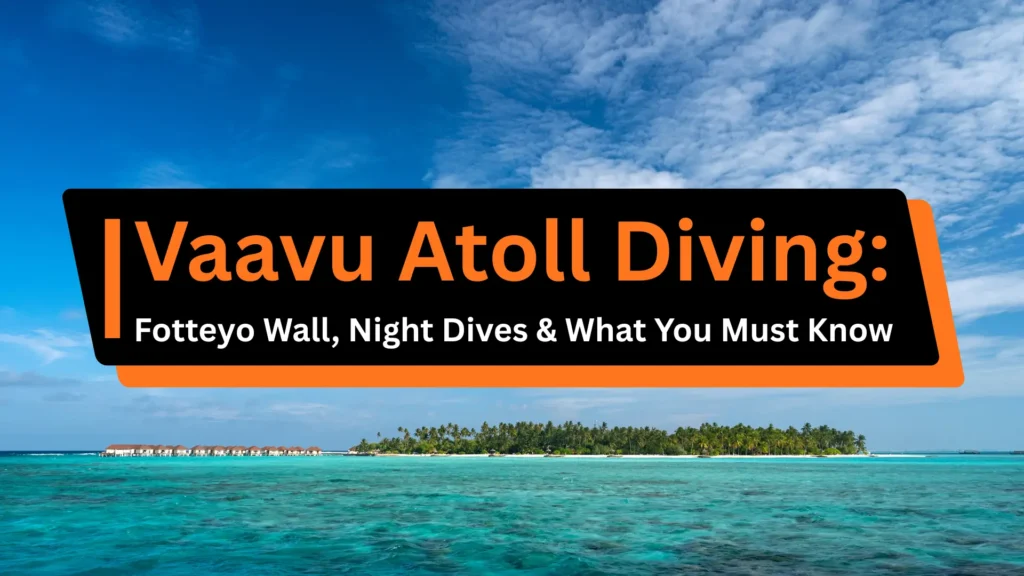
Vaavu Atoll Diving: Fotteyo Wall, Night Dives & What You Must Know
| 🚨 Important Safety Notice — Vaavu Atoll Cave Diving In 2026, a tragic accident in a Vaavu Atoll underwater cave system resulted in the deaths of five divers. This guide addresses cave diving safety directly and honestly. The open water and wall diving in Vaavu Atoll remains excellent and safe when conducted responsibly. Cave diving requires specialist training that recreational certifications do not provide. |
Vaavu Atoll is where the Maldives gets serious.
While other atolls offer gentle reef dives and predictable conditions, Vaavu delivers something different — powerful channel currents, dramatic wall diving, and the most famous night dive in the Maldives.
Fotteyo Wall drops from 5 metres to beyond 40. Miyaru Channel produces grey reef sharks and occasional tiger sharks in the blue water beyond. And at Alimatha Jetty every evening, dozens of nurse sharks and stingrays gather under the lights in one of the most extraordinary wildlife spectacles available to recreational divers.
This is not a beginner destination. But for divers ready for it — Vaavu Atoll is exceptional.
| ✍️ What draws me to Vaavu is the sheer drama of contrast. It’s where diving sheds its gentle, postcard-perfect image and transitions into something raw, powerful, and deeply cinematic. Standing on the edge of Fotteyo Wall, looking down into a vertical drop of deep oceanic indigo, or kneeling on the sand in the pitch black of Alimatha while dozens of massive nurse shark silhouettes slice through the beams of your dive light—it’s an adrenaline rush that forces you to be 100% present in the moment. It is the ultimate test of your skills and the ultimate reward for your curiosity. |
1. Vaavu Atoll Overview — Why It’s Different
Vaavu Atoll — officially Felidhu Atoll — sits approximately 70km southeast of Malé, separated from South Malé Atoll by the Vaadhoo Channel.
It is one of the least populated atolls in the Maldives — only 4 inhabited islands — which means the reefs are in exceptional condition and dive sites rarely crowded.
- 🌊 Famous for channel (kandu) diving — powerful tidal currents create extraordinary pelagic encounters
- 🏔️ Dramatic wall topography — Fotteyo Wall drops vertically from 5m to 40m+, covered in sea fans and soft corals
- 🦈 High shark density — grey reef sharks, white tips, and occasional larger species in the channels
- 🌙 Best night diving in the Maldives — Alimatha Jetty is unmissable
- 🤿 Advanced conditions — stronger currents and deeper sites than most Maldives atolls
- 🏝️ Minimal tourist infrastructure — authentic, uncrowded, genuinely remote feel
| 💡 Pro Tip: Vaavu Atoll rewards patient, experienced divers who are comfortable in current. The sites here are not difficult — but they require proper buoyancy control and current awareness. Divers who’ve mastered drift diving in North Malé or Ari Atoll will find Vaavu a natural and extraordinary progression. |
2. Cave Diving Safety — What You Must Know
The 2026 accident in Vaavu Atoll’s cave system has brought significant attention to cave diving safety in the Maldives. This section addresses it directly.
| ⚠️ Cave Diving Requires Specialist Certification Recreational scuba certifications — Open Water, Advanced Open Water, even Rescue Diver — do NOT qualify a diver to enter underwater cave systems. Cave diving is a technical speciality requiring specific training: Cavern Diver, Cave Diver, and Full Cave Diver certifications through PADI, TDI, or NAUI. Entering a cave system without this training is extremely dangerous regardless of dive experience. |
The Distinction Between Cave and Cavern Diving
- 🔦 Cavern Diving — The entry-level cave experience. Always within sight of natural light. A specific certification is required. Maximum depth 30m. Taught as a PADI specialty.
- 🕳️ Cave Diving — Beyond natural light. Complex navigation. Multiple gas requirements. Full cave certification required. Not suitable for recreational divers without specific training.
- 🏊 Open Water Diving in Vaavu — Completely separate from cave systems. Wall diving, channel diving, and night diving at Vaavu Atoll are recreational activities conducted in open water. Safe for Advanced OW certified divers with appropriate experience.
| The Bottom Line: The open water diving in Vaavu Atoll — Fotteyo Wall, Miyaru Channel, Alimatha Night Dive — is excellent recreational diving that is safe for Advanced Open Water certified divers with appropriate experience. Cave systems in Vaavu Atoll require specialist technical training. This guide covers recreational open water diving only. |
3. Best Dive Sites in Vaavu Atoll
| 📍 Fotteyo Wall (Fotteyo Kandu) Vaavu Atoll — southeastern channel | Depth: 5–40m+ | Level: Advanced |
| Widely considered the finest dive site in Vaavu Atoll and one of the greatest wall dives in the Maldives. A massive vertical wall dropping from 5 metres at the surface to beyond 40 metres, completely covered in enormous sea fans, soft corals in purple and orange, and overhangs packed with marine life. The channel current sweeps past the wall bringing pelagic visitors with it — grey reef sharks patrol in numbers, eagle rays cruise past in formation, and occasional hammerheads appear in the blue water beyond. 🦈 Marine Life: Grey reef sharks (many), eagle rays, Napoleon wrasse, enormous sea fans, soft coral coverage, occasional hammerheads, white tip reef sharks, reef fish in extraordinary density 💡 Dive Fotteyo on an outgoing current for the best pelagic action — when water is being pushed out of the atoll, sharks and rays congregate on the channel edge. Ask your guide to confirm current direction before the dive. |
| 📍 Miyaru Channel (Shark Alley) Vaavu Atoll | Depth: 15–35m | Level: Advanced |
| Miyaru means ‘shark’ in Dhivehi — and the name is accurate. This channel is famous for grey reef shark aggregations in the current-swept water, with occasional larger species including tiger sharks in the blue water beyond the channel mouth. A drift dive through the channel delivers some of the most intense shark action available in Vaavu Atoll. Not for the faint-hearted — or the inexperienced. 🦈 Marine Life: Grey reef sharks (aggregations), white tip reef sharks, occasional tiger sharks in open water, eagle rays, giant trevally, barracuda schools 💡 The channel is best dived on an incoming tide when sharks gather on the upcurrent side. The blue water beyond the channel mouth occasionally produces open ocean encounters with larger species. Stay with your guide — current here can be strong and unpredictable. |
| 📍 Alimatha Jetty (Night Dive) Vaavu Atoll — Alimatha Island | Depth: 5–15m | Level: All levels |
| The most famous night dive in the Maldives — and one of the most extraordinary wildlife encounters available to recreational divers anywhere on earth. Every evening as darkness falls, dozens of nurse sharks and stingrays gather under the lights of the Alimatha jetty to feed on fish attracted by the illumination. Divers kneel on the sandy bottom in 5–15 metres and watch as nurse sharks glide within touching distance (don’t touch) and large stingrays pass overhead. The density of animals is genuinely overwhelming. 🦈 Marine Life: Nurse sharks (dozens simultaneously), cowtail stingrays, feather-tail stingrays, reef fish attracted to lights, occasional eagle rays, bioluminescence in open water sections 💡 This dive genuinely does not require Advanced certification — it is shallow, calm, and conducted under lights. However, it is a night dive and requires proper night diving experience and equipment. Even divers who ‘don’t do night dives’ consistently describe Alimatha as one of the greatest experiences of their diving lives. Do not skip it. |
| 📍 Vattaru Reef Vaavu Atoll — outer reef | Depth: 5–30m | Level: Intermediate |
| A long, protected outer reef with excellent coral coverage and a wide variety of reef life. Less current than the channels — making it ideal for divers wanting to explore reef ecosystems without the intensity of channel diving. The reef extends for a considerable distance with varying depth profiles offering something for every level. 🦈 Marine Life: Hawksbill turtles, grey reef sharks, white tip reef sharks, moray eels, diverse reef fish, good coral coverage, occasional eagle rays 💡 Vattaru is the ideal introduction to Vaavu Atoll — excellent marine life without the demanding currents of Fotteyo or Miyaru. Start here to get a feel for the atoll before progressing to the channel sites. |
| 📍 Rakeedhoo Channel Vaavu Atoll — southern channel | Depth: 15–35m | Level: Advanced |
| A dramatic channel dive in the southern section of Vaavu Atoll with strong currents, good shark action, and beautiful reef formations on the channel walls. Less dived than Fotteyo due to its more remote location — making encounters here feel more genuinely wild and exclusive. 🦈 Marine Life: Grey reef sharks, white tips, eagle rays, channel topography with sea fans and soft corals, occasional pelagic visitors 💡 Rakeedhoo is only accessible on liveaboard routes that specifically cover southern Vaavu Atoll. Resort-based divers rarely reach it. One of the advantages of a Vaavu Atoll liveaboard route. |
4. Alimatha Night Dive — The Full Story

Of all the extraordinary dive experiences in the Maldives, the Alimatha Jetty night dive is the one that generates the most consistent superlatives from experienced divers.
Here is exactly what happens:
- As daylight fades, lights on the Alimatha jetty illuminate the water below.
- Small fish gather around the lights — attracted by the illumination.
- Nurse sharks, which spend their days resting under coral heads, become active at night and follow the fish.
- Stingrays — cowtail and feather-tail species — emerge from the sand and join the feeding activity.
- By full dark, the area under the jetty is dense with animals — nurse sharks gliding between divers’ legs, stingrays passing overhead.
- Divers kneel on the sandy bottom and simply watch — the sharks come to them, not the other way around.
- In the open water beyond the jetty lights, bioluminescence is often visible — plankton lighting up with every movement.
| ⚠️ Do Not Touch the Animals Nurse sharks at Alimatha are wild animals, not pets. They come close because they are habituated to divers — not because they want to be touched. Touching, riding, or grabbing nurse sharks is illegal, harmful to the animals, and risks injury to divers (nurse sharks can and do bite if provoked). Every diver must be briefed on this before entering the water. Operators who permit touching should be avoided. |
🏨 Want to dive Alimatha Jetty every single night? Check rates and book your stay at Alimatha Aquatic Resort directly here →
| 💡 Pro Tip: The Alimatha night dive is one of the few dives in the Maldives that is equally spectacular for relatively inexperienced divers and seasoned veterans. The shallow depth (5–15m), calm conditions, and illuminated environment make it technically accessible. The wildlife encounter makes it unforgettable. If you’re in Vaavu Atoll — this dive is non-negotiable. |
5. vaavu atoll Month-by-Month Season Calendar

Vaavu Atoll diving varies significantly by season — particularly for the channel sites:
| Month | Season | Visibility | Currents | Best Diving | Overall |
| January | Dry ☀️ | 25–35m | Strong & predictable | Fotteyo Wall, channels | ⭐ Excellent |
| February | Dry ☀️ | 25–35m | Excellent channel action | All sites | ⭐ Excellent |
| March | Dry ☀️ | 20–30m | Strong — best drift | Miyaru Channel, Fotteyo | ⭐ Excellent |
| April | Transition | 15–25m | Moderating | All sites | ✅ Very Good |
| May | Wet 🌧️ | 12–20m | Variable | Night dives excellent | 👍 Good |
| June | Wet 🌧️ | 10–18m | Weaker currents | Alimatha night dive | 👍 Good |
| July | Wet 🌧️ | 10–18m | Calmer conditions | Night dives, reef dives | 👍 Good |
| August | Wet 🌧️ | 10–18m | Calm — less pelagic | Reef life excellent | 👍 Good |
| September | Wet 🌧️ | 10–18m | Building again | Channels improving | 👍 Good |
| October | Transition | 15–25m | Good current returns | Fotteyo, Miyaru | ✅ Very Good |
| November | Dry ☀️ | 20–30m | Strong & clear | All sites excellent | ⭐ Excellent |
| December | Dry ☀️ | 25–35m | Peak conditions | Best month overall | ⭐ Excellent |
⭐ Excellent ✅ Very Good 👍 Good
| 💡 Pro Tip: November to April is peak season for Vaavu Atoll — dry season conditions bring the strongest, most predictable currents and the best visibility (25–35m). The channel dives at Fotteyo and Miyaru are at their finest during this period. The Alimatha night dive is excellent year-round — season has minimal impact on this particular experience. |
6. Who Should Dive Vaavu Atoll?
| ✅ Vaavu Atoll IS for you if: | ❌ Vaavu Atoll is NOT for you if: |
| You have Advanced OW + 30+ dives | You’re Open Water only |
| You’re comfortable with drift diving | You’ve never drift dived before |
| You want dramatic walls and channels | You prefer calm, gentle reef diving |
| Night diving interests you | You’re uncomfortable in the dark |
| You want a challenging Maldives experience | You want a relaxed beginner-friendly trip |
| You’re on a liveaboard covering Vaavu | You’re on a short resort-based trip |
Exception: The Alimatha night dive is accessible to all certified divers regardless of experience level — it is shallow, calm, and genuinely unmissable.
7. How to Access Vaavu Atoll
- 🚤 Speedboat from Malé — approximately 2 hours. Most resort transfers use speedboats. Cost: $60–$150 return per person.
- ✈️ Seaplane — not commonly used for Vaavu Atoll due to relatively short speedboat distance.
- 🚢 Liveaboard — the best way to dive Vaavu Atoll properly. South Malé + Vaavu liveaboard routes are available from several operators. Covers multiple channel sites including Fotteyo, Miyaru, and Alimatha in a single trip.
| 💡 Pro Tip: A dedicated Vaavu Atoll liveaboard route (5–7 nights) is the ideal way to experience this atoll. It gives you multiple dives at Fotteyo and Miyaru across different tides and conditions — significantly better than the 1–2 site day trips available from South Malé resorts. |
| 🚢 To dive Fotteyo and Miyaru at the perfect tide, a liveaboard is essential. Compare South & Central Maldives Liveaboard Rates & Availability → |
8. Best Resorts in Vaavu Atoll

Vaavu Atoll has fewer resorts than the main atolls — which contributes to its uncrowded, authentic character:
- 🏨 Alimatha Aquatic Resort — The only resort on Alimatha Island. Direct access to the famous Alimatha night dive from the jetty. The obvious choice for divers specifically coming for this experience. Mid-range pricing from approximately $200–$400/night before TGST.
- 🏨 Vilu Reef Beach & Spa Resort — On Dhiggiri Island. Good dive centre with access to main Vaavu sites. Mid-range to luxury pricing.
- 🏨 Vaali Maldives — Newer property with good dive access. Less established but positive early reviews.
- 🚢 Liveaboard (recommended) — For serious divers wanting full Vaavu Atoll coverage including Fotteyo Wall and Miyaru Channel across multiple tides and conditions.
- 🏨 Want to dive Alimatha Jetty every single night? Check rates and book your stay at Alimatha Aquatic Resort directly here →
9. Frequently Asked Questions

Q: What is Vaavu Atoll famous for?
A: Vaavu Atoll (Felidhu Atoll) is famous for three things: Fotteyo Wall — one of the finest wall dives in the Maldives; Miyaru Channel — outstanding shark action in powerful currents; and the Alimatha Jetty night dive — the most famous night dive in the Maldives, where dozens of nurse sharks gather under the jetty lights.
Q: Is Vaavu Atoll suitable for beginners?
A: The channel dives (Fotteyo Wall, Miyaru Channel) require Advanced Open Water certification and drift diving experience — not suitable for beginners. However, the Alimatha Jetty night dive is accessible to all certified divers regardless of experience. Vattaru Reef also offers gentler conditions for intermediate divers.
Q: What happened in the Vaavu Atoll cave diving accident?
A: In 2026, five divers died in an underwater cave system in Vaavu Atoll. The incident underscores the critical importance of proper technical cave diving certification before entering cave systems. Recreational scuba certifications do not qualify divers for cave penetration. The open water diving in Vaavu Atoll — walls, channels, and night dives — is completely separate from cave systems and remains safe for qualified recreational divers.
Q: Is the Alimatha night dive worth it?
A: Unequivocally yes. The Alimatha Jetty night dive — where dozens of nurse sharks and stingrays gather under the lights in 5–15m of water — is consistently described by experienced divers as one of the greatest wildlife encounters available anywhere in the Maldives. It is also accessible to all certified divers regardless of experience level.
Q: When is the best time to dive Vaavu Atoll?
A: November to April (dry season) for the strongest, most predictable currents and best visibility at Fotteyo Wall and Miyaru Channel. The Alimatha night dive is excellent year-round — minimal seasonal variation. The wet season (May–October) offers calmer conditions and is good for reef diving, but the channel action is reduced.
Q: How do I get to Vaavu Atoll?
A: Speedboat from Malé — approximately 2 hours, $60–$150 return per person. Most resorts arrange transfers directly. Liveaboards depart from Malé and include Vaavu in their route. Seaplane is not commonly used for Vaavu Atoll.
Q: What certification do I need for Vaavu Atoll?
A: Advanced Open Water minimum for the channel dives (Fotteyo, Miyaru). Open Water with night diving experience for the Alimatha night dive. No cave diving certification is needed for open water sites — but cave certification is mandatory for entering any cave system, regardless of overall diving experience.
Final Word
Vaavu Atoll is the Maldives for serious divers.
Fotteyo Wall at full current — sea fans the size of trees, grey reef sharks materialising from the blue, the wall dropping into darkness below you.
Miyaru Channel on an incoming tide — the channel full of sharks, the water pushed hard through the gap, everything moving.
And then Alimatha at night — kneeling on the sand while nurse sharks glide between your arms and the lights of the jetty above make the whole scene feel like something from another world.
Dive it properly. Respect the conditions. And it will give you some of the finest diving in the Maldives.
Explore More
- 🗺️ Best Dive Sites in the Maldives
- 🌊 Baa Atoll Diving
- 🗺️ Ari Atoll Diving → /ari-atoll-diving/
- 🚢 Maldives Liveaboard Diving Routes
- 📅 Best Time to Dive Maldives
- 🤿 Maldives Divers Complete Guide